







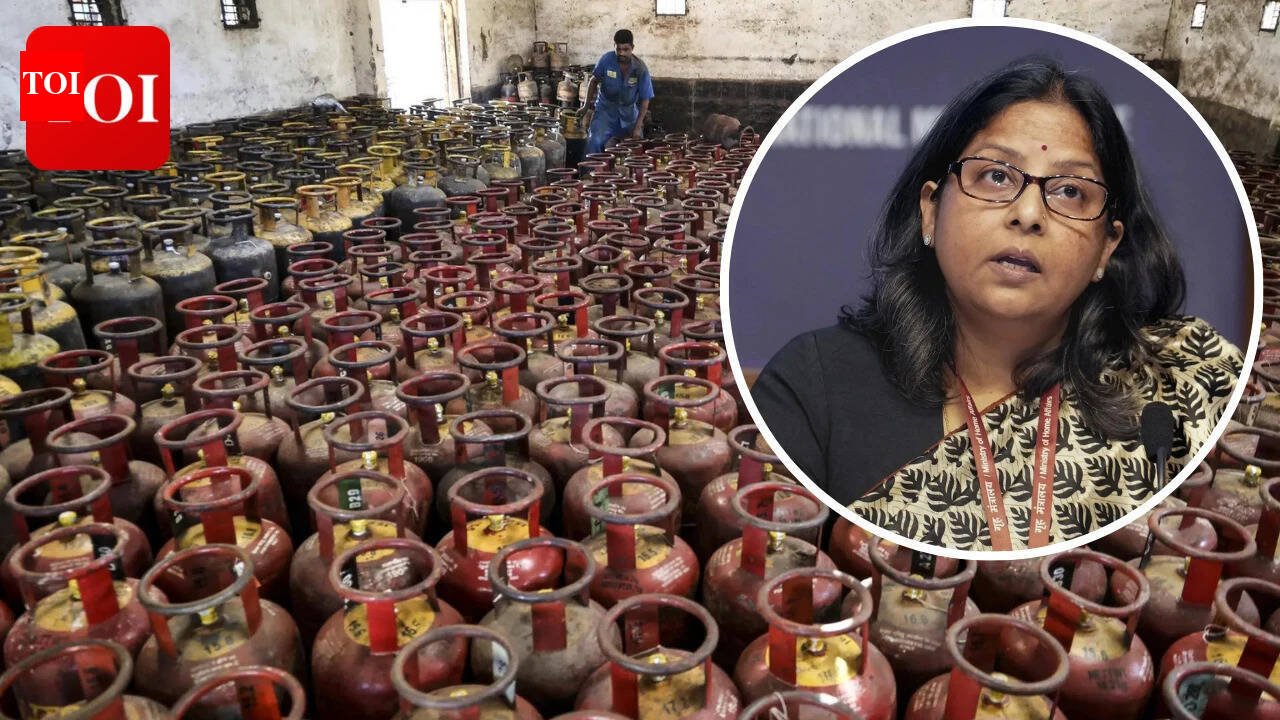

NEW DELHI: Public concern over a possible shortage of LPG and other fuels is mounting, but the Centre assures that there is no reason to panic. The closure of the Strait of Hormuz has led to disruptions in oil supply amid the ongoing US-Israel-Iran war. The government said that the citizens should avoid panic booking and conserve fuel during these uncertain times.Sujata Sharma, joint secretary at the ministry of petroleum and natural gas, during a press briefing said, “There is a manifold increase in the bookings because of the panic. We urge the citizens to avoid panic booking and all efforts have to be made to conserve the fuel wherever possible during this period of global uncertainty.” Sharma also said that the retail network across the country is functioning smoothly, with nearly 100,000 fuel outlets operating without any dry-outs. She added that around 25,000 LPG distributors are supplying roughly 50 lakh cylinders daily, ensuring uninterrupted household access.Commercial LPG supplies are being prioritised for hospitals and educational institutions, with a three-member committee of executive directors from oil marketing companies overseeing allocations to prevent hoarding or black marketing.Sharma also added that India’s refineries are working at maximum capacity to boost LPG output.“Yesterday I told you 25%. Now it is 28% of our domestic production. So that is the increase,” she said, referring to the government’s March 9 order under the Essential Commodities Act directing refineries to maximise LPG production.She noted that India, the world’s fourth-largest refiner, processes nearly 55 million barrels of oil per day, providing a significant buffer against global shocks.Despite the closure of the Strait of Hormuz — a vital shipping lane for global energy transport — Sharma said the government’s intervention has ensured continued imports through alternate routes.“So today is the 13th day of the war, and the Hormuz for the commercial shipping is closed. This is very important in the context that we do take lot of import from the Strait of Hormuz. Although after the intervention of the government, as on today, more than 70% of our import is coming through routes other than the Strait of Hormuz,” she said.To ease pressure on LPG and natural gas channels, the government has also stepped up supplies of alternative fuels.Kerosene allocations to states are being raised, and coal distribution for small and medium consumers is being scaled up. The Environment Ministry has advised state pollution boards to temporarily allow restaurants and hotels to use biomass, RDF pellets, kerosene or coal for a month.Daily coordination between oil marketing companies and state governments continues to ensure a steady supply, monitor demand patterns and enforce regulations. District-level committees have been tasked with preventing diversion, hoarding and misuse of fuel stocks.


