






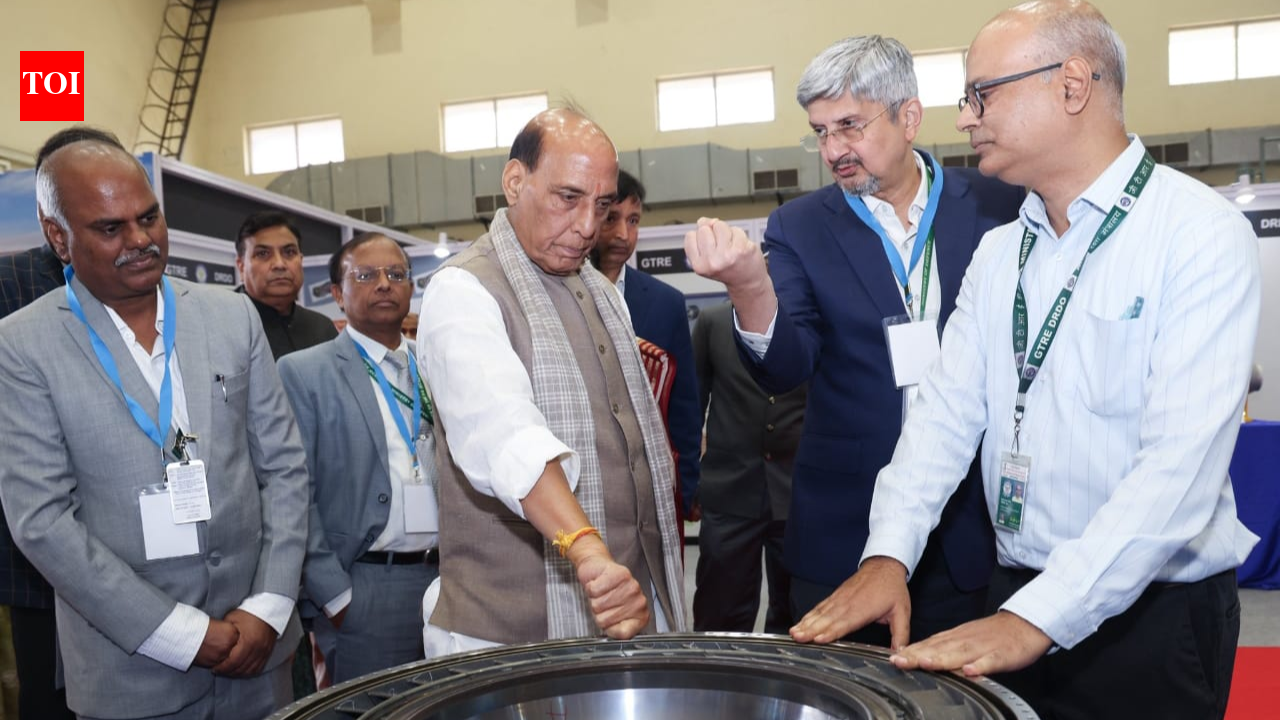

BENGALURU: Defence minister Rajnath Singh Monday visited DRDO’s Gas Turbine Research Establishment (GTRE) in Bengaluru, where he reviewed the progress of indigenous military gas turbine engine programmes, including the long-running, much-delayed Kaveri engine project.On Tuesday, Singh, along with French minister of defence Catherine Vautrin, will inaugurate the Tata Advanced Systems’ final assembly line for the Airbus H125 helicopter in Kolar. Vautrin, who is arriving in Bengaluru early Tuesday for the “India France Annual Bilateral Dailogue”, is expected to receive a formal guard of honour along with Singh at the HAL airport here. During the visit on Monday, Singh called on GTRE to focus on next-generation propulsion systems and build a nationwide ecosystem to support advanced engine development. Referring to India’s plans for the Advanced Medium Combat Aircraft (AMCA), he said the country must move beyond fifth-generation capabilities. “We cannot limit ourselves to only 5th generation engines. We must begin the development of 6th generation, advanced technologies as soon as possible,” he said, highlighting the growing role of AI, machine learning and new materials in propulsion technologies.Describing aero engine development as a complex integration of thermodynamics, materials science, fluid mechanics and advanced mechanical engineering, Singh noted that even advanced nations take 25 to 30 years to develop next-generation engines. He urged Indian scientists to compress timelines in view of strategic requirements. “We must assume that 20 years have already passed and we now have only 5–7 years left,” he said. Referring to Operation Sindoor, he said the armed forces had demonstrated growing self-reliance through the use of indigenous communication systems, surveillance equipment and weapon platforms. He also welcomed joint studies with the UK and France under the National Aero Engine Mission, stating that such partnerships would help India understand technological challenges while building domestic capability.Singh was briefed on ongoing engine development efforts, collaboration with Indian industry, academia and research institutions, and the technical support extended to the armed forces. Singh toured an exhibition of indigenously developed engines and components and witnessed a full afterburner engine test of the Kaveri engine, a key milestone in India’s push for aero engine self-reliance.Interacting with scientists and officials, Singh described DRDO as the foundation of India’s strategic capability and stressed the need to achieve Aatmanirbharta in aero engine technology amid a shifting geopolitical landscape. “Supply chains are breaking and new ecosystems are developing. Nations possessing indigenous critical technologies will remain safe, secure and sustain themselves,” he said, reiterating the govt’s commitment to self-reliance.Secretary, department of defence R&D and DRDO chairman Samir V Kamat, along with senior GTRE scientists and officials, were present during the visit.


