







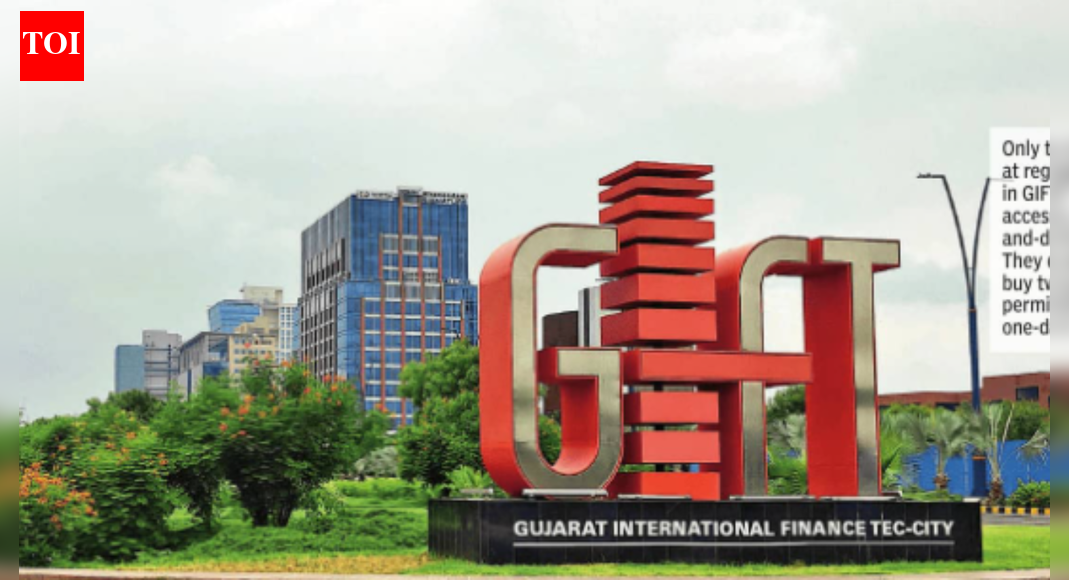

When Gujarat lifted its prohibition laws within GIFT City on New Year’s Eve 2023, it made national headlines. For a state where ‘dry’ has been a foundational principle since 1960, the move to create a watering hole where professionals could socialise — even if within the perimeters of India’s first international financial hub — felt audacious.Two years later, the glass remains half full, measured rather than overflowing. Official figures show 985 permanent employees with liquor access permits and 5,291 temporary ones for visitors. With 5,552 bulk litres of liquor sold to date — a modest but telling figure — Gujarat’s experiment with controlled conviviality proves that even in prohibition territory, business pragmatism can find a way.Policy To PracticeInside GIFT City, every drink has a paper trail. Gujarat’s first taste of legal liquor operates within one of the most controlled ecosystems in the country: precise, trackable and fenced in by policy.Only those employed with registered firms in GIFT City can raise a glass — and only after securing a two-year access permit, renewable for Rs 1,000 annually. Visitors can join in, but only through one-day temporary permits issued by an authorised recommending officer.Each permit holder is allowed to host up to five guests at a time within licensed ‘wine and dine’ zones — sealed-off spaces inside hotels, clubs and restaurants operating under a designated foreign liquor licence. While there is no official limit on consumption volume, everything is billed and recorded.Even with a valid permit, the glass must stay within these designated zones. Every guest’s name is registered before service, every bill traceable, and yes, even Ahmedabad residents can be invited, provided the meeting is deemed business-related. The guardrails extend beyond the bar counter. Those who drink cannot drive; they must leave with a designated driver. In case of an inquiry, a wine-and-dine bill serves as proof of authorised consumption — every toast documented in detail within Gujarat’s carefully calibrated social experiment.Going With The FlowGIFT City’s social scene operates within tight boundaries. Currently, two wine-and-dine facilities serve the zone, with more planned as new commercial towers and hotels open.Taral Shah, a developer working on projects in GIFT City, said: “GIFT City is India’s only operational International Financial Services Centre (IFSC) and smart city, and we have seen interest growing among foreign companies year by year. With liquor norms relaxed, companies from Delhi, Mumbai and Bengaluru are also setting up base in GIFT City. We expect more facilities as additional buildings become operational. We also hope that taxes will come down because wine-anddine facilities here primarily serve the salaried class. When the govt announced the relaxation two years ago, real estate enquiries in GIFT City saw a sudden jump of 25-30%.”
–
The impact extends beyond realty metrics. An official at one of the licensed wine-and-dine facilities said the relaxation has transformed the sentiment within GIFT City: more employees now stay back in the evenings to catch up over drinks.“On weekdays, we see an average of about 15 people coming in to wine and dine. The number doubles to around 30 on weekends. The VAT is higher than other states, but we expect it to be rationalised soon and brought on a par with other states, which should further drive consumption,” the official said.The shift is reshaping the everyday rhythm at GIFT City as professionals embrace post-work socialisation. “The relaxation of liquor laws is a welcome move. The process of obtaining access is also convenient and easy. GIFT City is successfully creating a lifestyle and culture that matches international standards,” said Dhruv Singh (name changed), a professional working at GIFT City. Small changes signal larger shifts. Earlier, photography was banned at these facilities, but that restriction has been lifted — suggesting that GIFT City is easing into its new culture of controlled comfort.Choice Of DrinksThe demographics tell their own story: 15% of visitors at GIFT City’s wine-and-dine facilities are foreigners, while 85% are Indian, primarily employees and their occasional guests. The typical patron is between 26 and 45 years old. Beer dominates, with most patrons preferring to unwind over a pint or light drink after work. Spirits see lower uptake, likely due to both preferences and higher taxation.The licensed facilities operate from 11am and attract some daytime visitors, too, though crowds peak in the evenings. “We’re also seeing small groups using the space for formal and informal business discussions,” said a hotelier.Corporate CautionNot every company, however, is ready to raise a toast just yet. Some firms deliberately avoid issuing permission letters for employees to access these facilities.“Our organisation has made a conscious decision to not issue letters to employees for drinking at the wine-and-dine facilities at GIFT City. Since alcohol prohibition continues beyond GIFT City limits, companies are worried about any incident that could tarnish their reputation,” explains Tanya Sharma (name changed), who works with an MNC at GIFT-IFSC.Hospitality PotentialIndustry leaders see broader potential. Narendra Somani, president of the Hotels and Restaurants’ Association (HRA), Gujarat, argues that two years of regulated liquor access at GIFT City shows how controlled liberalisation can help build a wineand-dine culture while also generating revenue for the state.
–
“Govt should consider extending such relaxations in a regulated manner across Gujarat, especially with increasing foreign investments in Ahmedabad, a growing expat community, and Gujarat’s bids for the Commonwealth Games 2030 [which it won on Wednesday] and the 2036 Olympics. Gujarat’s hospitality sector loses social and corporate event business to other states. With thoughtful liberalisation, Gujarat’s tourism industry could take a significant leap forward,” Somani said.‘Global Readiness’Sanjay Kaul, IAS, MD and group CEO, GIFT City, said: “The streamlining of prohibition norms specific to GIFT City has been widely welcomed by companies and professionals, who see it as a reflection of the city’s global readiness.”The numbers may appear modest, but they represent Gujarat’s incremental approach to social liberalisation within an economic enclave, carefully avoiding any challenge to the broader prohibition framework across the state.
–
A senior official emphasises that the relaxation aligns with GIFT City’s ambition to position itself as a global financial hub.“Several companies in GIFT City had identified prohibition as a challenge in attracting young talent. Since the relaxation, we have growing traction from global firms and multinational corporations. Previously, semiconductor design companies favoured Bengaluru or Hyderabad. But now, with a semiconductor manufacturing cluster coming up in Gujarat, GIFT City has become a viable alternative,” a GIFT City official said.Recent developments support this claim. Sources confirmed that a European semiconductor design firm recently established an office in GIFT City. “Global corporations require wine-and-dine facilities not just for employees but also for hosting international clients. With world-class infrastructure, airport connectivity, and the recent easing of liquor norms, GIFT City now stands on a par with other global financial hubs,” the official added.Larger QuestionGIFT City’s liquor model remains unique: a closed-loop ecosystem where access, sale, and consumption are all verified and logged — an administrative “wet bubble” in an otherwise dry state.As GIFT City expands with new corporate tenants and residential projects, the central question persists: will Gujarat replicate this model elsewhere, or will it remain a singular concession at India’s global financial hub?For now, Gujarat’s controlled experiment continues — each glass raised within GIFT City represents not just a drink, but a data point in one of India’s most closely-watched policy experiments.


